Why This Question Matters
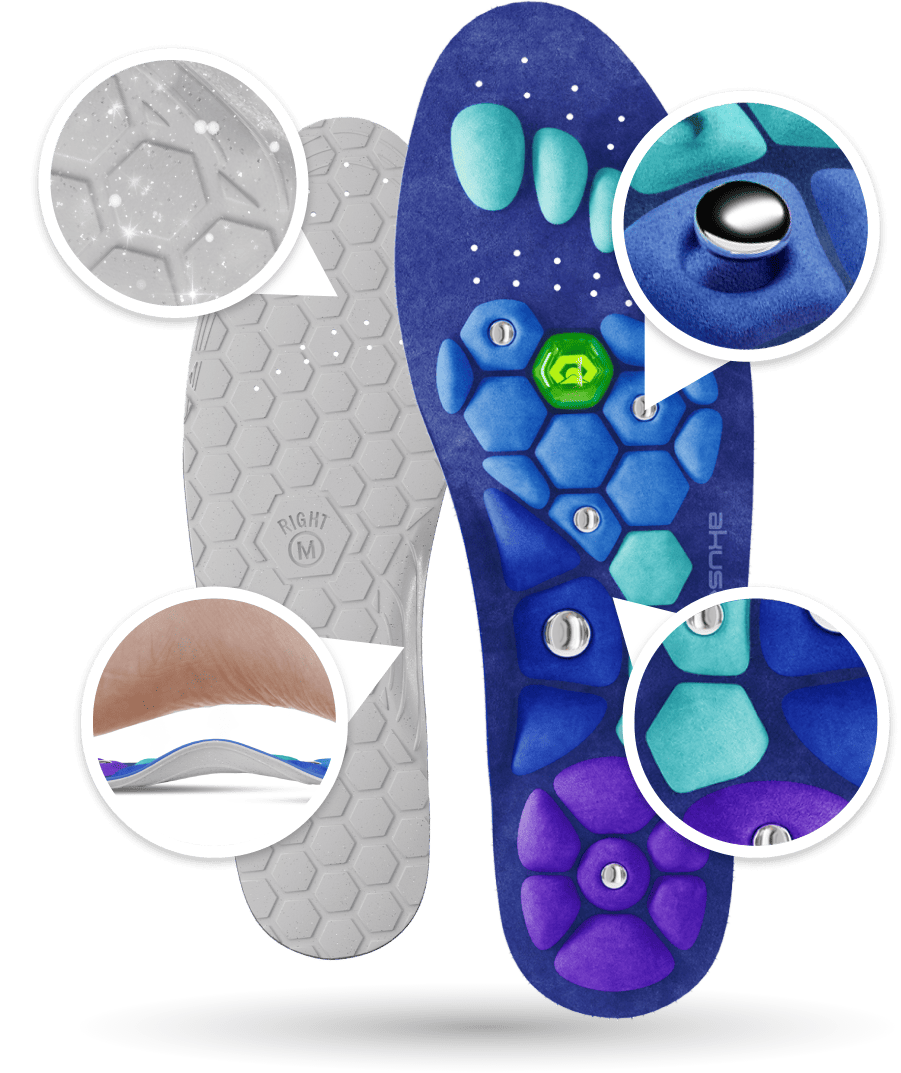
Magnetic and acupressure insoles have been sold for decades on the promise of improved circulation and pain relief, and products like Akusoli include these features as part of a broader design. Before deciding whether that part of the design matters to your buying decision, it's worth knowing what independent, peer-reviewed research has actually found — not just what product pages claim.
What Is Static Magnet Therapy Supposed to Do?
Static magnet therapy is the use of permanent (non-electric) magnets placed against the body — in insoles, wraps, or bracelets — on the theory that magnetic fields increase local blood flow and interrupt pain signaling. The theory sounds physically plausible at first glance, which is part of why it has remained popular in consumer wellness products.
Static magnets used in commercial insoles are typically far weaker than the field strengths used in actual medical technology like MRI machines, and human tissue is not strongly magnetic, which is the starting point researchers use to test whether any biological effect is detectable at all.
What Did the Clinical Trials Find?
Several randomized, double-blind, placebo-controlled trials — the gold standard of medical research — have directly tested magnetic insoles against identical-looking sham (non-magnetic) insoles. Across these trials, the consistent finding is that both groups improved by a similar amount, meaning the magnets themselves added no measurable benefit.
A 2003 trial published in JAMA followed 101 adults with plantar heel pain for eight weeks. Both the magnetic-insole group and the sham group showed significant pain improvement, with no statistically significant difference between them — see the study summary on PubMed.
A separate trial in Mayo Clinic Proceedings tested magnetic insoles on workplace-related nonspecific foot pain in 89 participants over eight weeks and reached the same conclusion — the insoles were not clinically effective compared with sham insoles.
A smaller crossover trial of a commercial magnetic insole brand also found no statistically significant therapeutic effect for plantar fasciitis, even though some participants reported subjectively wanting to keep using the insoles afterward — a pattern researchers often attribute to the placebo effect and the comfort of the cushioning itself, detailed in the published trial results.
The American Academy of Family Physicians summarized this body of evidence directly: cushioned insoles with magnets are no more effective than identical cushioned insoles without magnets for foot pain relief.
So Why Do Some People Feel Better Wearing Them?
People who wear magnetic insoles often do feel genuine improvement — but trial evidence suggests that improvement tracks with the cushioning and the placebo response, not the magnets specifically. The sham groups in every trial cited above improved by comparable amounts, which is why researchers use sham-controlled designs in the first place: to separate the effect of belief and comfort from the effect of the magnetic field itself.
What About Acupressure Zones?
Acupressure and reflexology are traditional practices, most closely associated with Chinese and other East Asian medical traditions, based on maps of the foot where specific zones are said to correspond to organs and systems elsewhere in the body. This mapping has no established basis in human anatomy or physiology — there is no known neural or circulatory pathway connecting, for example, a specific zone on the big toe to the pituitary gland, as some reflexology charts claim.
Controlled studies of reflexology for treating specific medical conditions have generally not found reproducible therapeutic effects beyond relaxation and touch-based comfort, which is well documented in general and does not require the pressure-point framework to explain.
This section summarizes the general scientific consensus on reflexology; it is not a systematic review of every published study.
What Does Have Real Evidence: Arch Support & Cushioning
In contrast to magnets and acupressure mapping, structural arch support and cushioning are supported by orthopedic and biomechanical research. A 2026 finite-element analysis published in the Journal of Experimental Orthopaedics found measurable short-term pressure redistribution from arch-support insoles, correlated with reported pain improvement in plantar fasciitis patients.
This is the mechanical logic behind the arch-support layer in insoles like Akusoli — spreading load away from the plantar fascia is a well-understood, physically explainable mechanism, unlike the magnetic and acupressure elements.
The Bottom Line
If you're considering a magnetic acupressure insole like Akusoli, the honest research summary is: the cushioning and arch support are doing the real mechanical work, the antimicrobial coating is doing genuine hygiene work, and the magnets and acupressure zones are along for the ride — pleasant to some, but not proven pain-relief tools in controlled research.